
Which Kootenai County Deed Records Fit the Transfer
The Kootenai County Recorder sits at the center of the title chain. Its deed records cover grants, mortgages, releases, easements, liens, plats, surveys, probate-admitted wills, lis pendens, and other instruments. Any of these can affect title to a parcel.
Check the instrument type first. A filing is not always a full transfer of ownership. Reading the deed itself tells you what actually changed hands in Kootenai County.
| Deed Type | What It Does | Common Use |
|---|---|---|
| Deed or grant | Transfers an interest in described land | Ordinary chain research |
| Quitclaim deed | Conveys the interest the grantor may have | Interest cleanup or related-party transfer |
| Personal-representative or trustee deed | Transfers through a fiduciary | Estate or trust administration |
| Tax, sheriff, redemption, or patent deed | Records a special statutory transfer | Tax sale, enforcement, redemption, or patent trail |
| Easement deed | Creates or conveys a limited access or use right | Road, utility, water, or access research |
A deed moves an interest in land. A mortgage, deed of trust, or lien only burdens one. Both types can sit side by side in Kootenai County deed records. That is why the filing order matters. Later documents often tell the rest of the story. Look for a reconveyance, a release, a satisfaction, or a final court disposition. Assume where the parcel stands today only after those.
Search Kootenai County Deeds With Recorder Index Fields
The Kootenai County Real Estate Index lets you search by party name, instrument number, or legal description. Each hit can return the grantor, grantee, recording date, document type, instrument number, and book/page citation when one exists. Treat a name match as a lead only. Compare the land description on the actual image before trusting the result.
| Search field | What it finds | Check next |
|---|---|---|
| Grantor | Documents from a transferring party | Grantee and legal description |
| Grantee | Documents to a receiving party | Grantor and acquisition date |
| Instrument number | A specific recorded filing | Image, type, and cross-references |
| Legal description | Instruments tied to recorded land terms | Lot, block, subdivision, or STR match |
| Book/page | An older or alternate recording reference | Recorder copy or linked volume |
County guidance asks researchers to pull the legal description from an Assessor address first. That step cuts down same-name errors and keeps the deed search pinned to a single parcel.
Kootenai County Recording Coverage Starts in 1881
Recorded documents in Kootenai County begin in 1881, per the Recorder. Its online instructions highlight a 1996-present path. That wording does not mean older images are missing. A long chain may still need office terminals, deed books, microfilm, or staff help locating a book/page reference.
Viewing online is free. For in-person research, visit 451 Government Way in Coeur d'Alene. It is open on weekdays from 9:00 to 5:00. Staff can show you the terminal. They cannot run the search or interpret the title chain for you.
Follow the Kootenai County Grantor-Grantee Index
A grantor-grantee index sorts Kootenai County deeds by who transferred and who received each interest. Start from one known current instrument. Read both parties and the exact legal description, then follow the cross-references rather than assuming every same-name hit involves the same land.
- Find the acquisition deed with the current party listed as grantee.
- Read the grantor, recording date, instrument number, and full legal description.
- Search that grantor as an earlier grantee and compare the same land terms.
- Repeat while noting deeds, easements, financing documents, and releases separately.
- Move to office books or archived material when the online route no longer carries the chain.
- Grantor
- The party transferring an interest.
- Grantee
- The party receiving an interest.
- Chain of title
- The linked sequence of recorded transfers for the same land.
- Book/page
- A volume and page reference used to locate a recorded document.
- Instrument number
- A filing identifier assigned to a recorded instrument.
Use Kootenai County Codes for Plats, Surveys, and Corners
The Recorder's PA environment relies on distinct document codes. It uses SP for plats, SS for surveys, and SL for land corners or corner-perpetuation filings. Section, Township, and Range works well as a locator across all three. These filings are not deeds. Yet they often explain the legal description attached to one.
One local example ties Coeur d'Alene's Twelve Hundred Flats project to Pinecrest Addition, Book of Plats page 90, and the northwest quarter of Section 11, Township 50 North, Range 4 West. That bridge from city packet to county record shows why project files can hand you search terms. The recorded instrument still governs.
Read Kootenai County Financing and Release Instruments Separately
County codes separate deeds of trust and mortgages from the paperwork that follows them. Kootenai County lists MD for a deed of trust or mortgage. MY means fixtures are included. RC marks a reconveyance. A paid-off loan is not the same thing as a recorded release.
Search forward from the financing instrument for the reconveyance, satisfaction, or other release. For a lis pendens or judgment lien, track down the court case. Check its final disposition too. Deed records here show what was filed. They do not rank the legal priority of competing claims.
Kootenai County Easements May Explain Access Without a Sale
An easement deed or right-of-way filing can change how land gets used. So can a lease affecting possession or a water-related instrument. None of them require selling the whole parcel. Read the exhibit and legal description closely. Does the right burden the land, benefit it, or cross a larger parent tract? Then search forward for amendments, releases, or later filings that refer back to it.
A road drawn on a plat or county map may not be public. Keep that caution in mind. It makes the recorded plat and the easement text decisive whenever legal access is disputed. Compare monuments, bearings, distances, lot labels, and recording references. A route shown on KCEarth helps you get oriented. It cannot define the scope of a private access right.
Historic Kootenai County Deeds Need More Than a Name Index
Research on older chains may start well outside the recorder's office. A deed book, subdivision plat, or city directory can open the trail. A newspaper or probate lead helps too. So does a FamilySearch catalog entry. The Idaho State Archives can help. So can the Coeur d'Alene Public Library's Idaho Collection. The Museum of North Idaho and the Kootenai County Genealogical Society help too. Each can pin down an old owner spelling, business name, addition, or address.
Treat those sources as finding aids, never as substitutes for Kootenai County deed records. Bring each clue back to the Recorder. Match the legal description, book/page, instrument, and connected parties. A probate file explains who had authority for an estate transfer. The recorded deed still proves what entered the land record. Keep aliases and project-name changes in your notes so earlier filings do not slip past.
Get a Plain or Certified Kootenai County Deed Copy
Recorded documents can be viewed online at no charge. A mail copy request should identify the instrument number, party names, recording date and type, book/page, and a return contact. Research copies run $1 per page. Certification adds $1, and return mail adds another $1. Confirm the current fees before sending payment.
Mail a check or money order with the request, or visit the Recorder's counter. Email submissions are not accepted for recording. New originals may be mailed or presented over the counter, and they generally must be complete, signed by the grantor, and notarized. The instrument should also carry a legal description or a reference to a prior instrument affecting the property.
Recorded, not guaranteed. The Kootenai County deed index reports filings, not a title opinion. Unrecorded interests and unresolved priority questions may remain, so use qualified title help when rights depend on the answer.
The official Real Estate Index appears in the captured county portal view below.
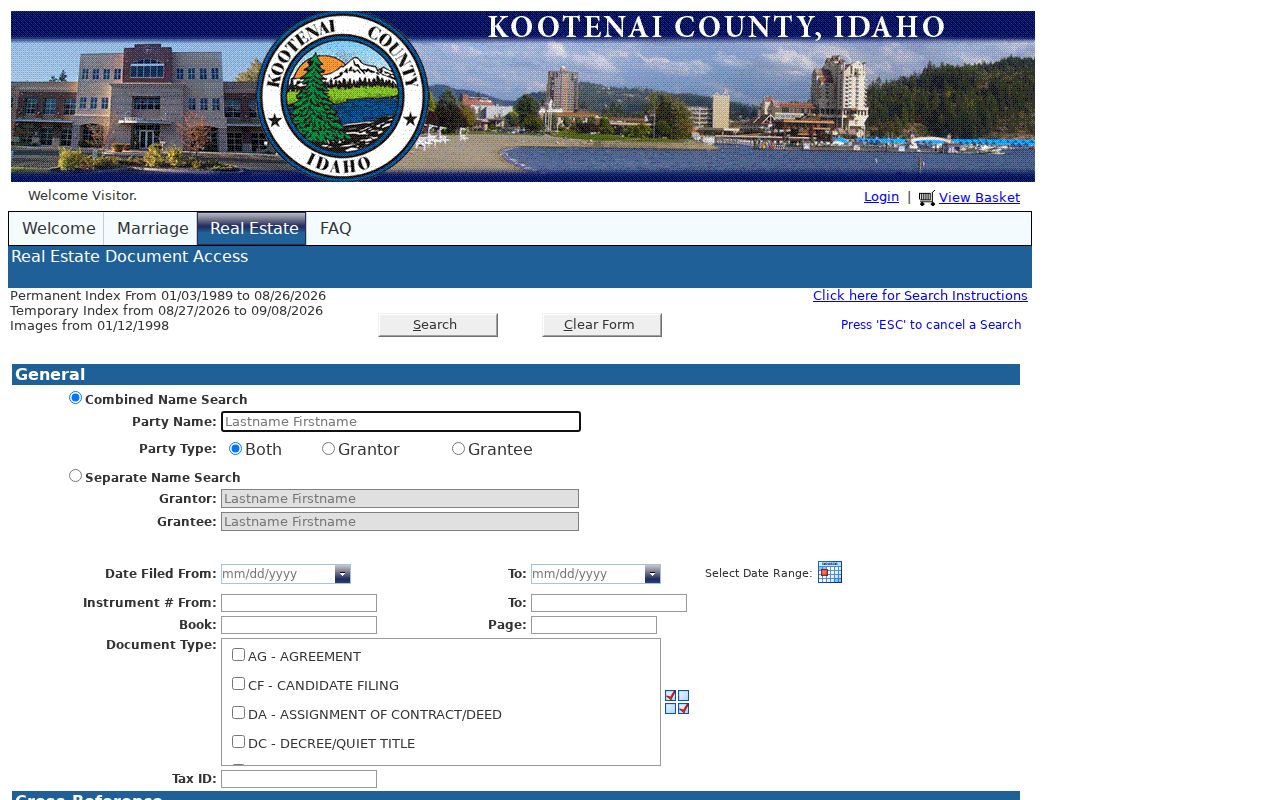
An index entry is only a starting point; the recorded document image is what verifies the land description.
Recording fees for new instruments follow a different table than research-copy fees. County examples list $15 for several deed categories. A deed of trust or mortgage runs $45. A plat costs $11. Surveys run $5 per page. Other standard instruments may run $10 for the first page plus $3 for each added page, with separate rules for long documents. These figures can change, and none of them sets the price of a requested copy. Confirm the current table before presenting an original. Never email a document for recording.
A deed's legal description deserves a line-by-line read. For platted land, check subdivision, block, lot, and any replat reference; for unplatted land, compare Section, Township, Range, aliquot part, bearings, distances, and exceptions. Read any incorporated exhibit too. A matching street address is not enough. Addresses get reassigned, and a mailing address may belong to the owner rather than the land.
Special transfers may need a second custodian. A personal representative's deed can point to probate authority held by District Court, and a tax deed should be compared with Treasurer sale and redemption material. A sheriff deed, lis pendens, or judgment lien may connect to an iCourt case. The court record explains the proceeding. Kootenai County deed records show what entered the land-record system. Neither should be silently substituted for the other.
Preserve exact party spelling and capacity. Also record the recording date, instrument type, instrument number, book/page, and legal description. Mark each item as an index row, an image, a plain copy, or a certified copy. That discipline stops a search result from being cited as though the deed itself had been read, and it gives Recorder staff enough detail to locate a copy without interpreting the chain.