
Kootenai Property Value Types
Each value record answers a different question. Assessment figures in Kootenai County support the tax bill, deed records document a transfer, and private opinions serve one date and purpose.
| Property Value | What It Is | Where |
|---|---|---|
| Assessed or market value | County estimate as of the annual valuation date | Assessor account and notice |
| Net taxable value | Assessed value after applicable exemptions or caps | Assessment and tax record |
| Last sale price | Consideration tied to a recorded transfer, when reported | Deed or sale field |
| Private appraisal | Professional opinion for a stated effective date | Not a county record value |
Idaho requires assessment at full market value less exemptions. State ratio studies compare assessment with sale price at the county level, and they never appraise a single parcel.
Kootenai Values Date to January
Kootenai assessment notices report market value as of January 1 and arrive near the end of May. The county attempts a physical inspection once during a five-year cycle. New improvements, neighborhood sales, and market movement can change a later assessment.
A renovation, permit, or sale after January 1 may not be reflected in that year's number. Save the assessment year before comparing it with a current asking price or later transfer.
Check Kootenai Assessed Value
The Assessor Parcel Search accepts address, owner, PIN, AIN, and legal description. Use PIN as the strongest cross-system key.
- Search the address or enter the full PIN without dashes. Use the six-digit AIN only in its own mode.
- Confirm situs and legal description before copying land, improvement, total, exemption, or sale fields.
- Record the valuation year and retrieval date.
- Check the recorded deed when a last-sale comparison is needed.
- Assessed value
- The county value placed on the property for assessment.
- Market value
- The county's full-value estimate as of the assessment date.
- Assessment ratio
- Assessed value divided by sale price in ratio-study analysis.
- Sale consideration
- The price or value stated for a transfer.
- Reassessment
- A new county valuation, not a private appraisal.
Kootenai Tax Search Adds Context to Property Value
The official Treasurer tax search accepts PIN, AIN, primary owner, property address, or mailing address once the parcel is identified. It links the parcel to its tax account.
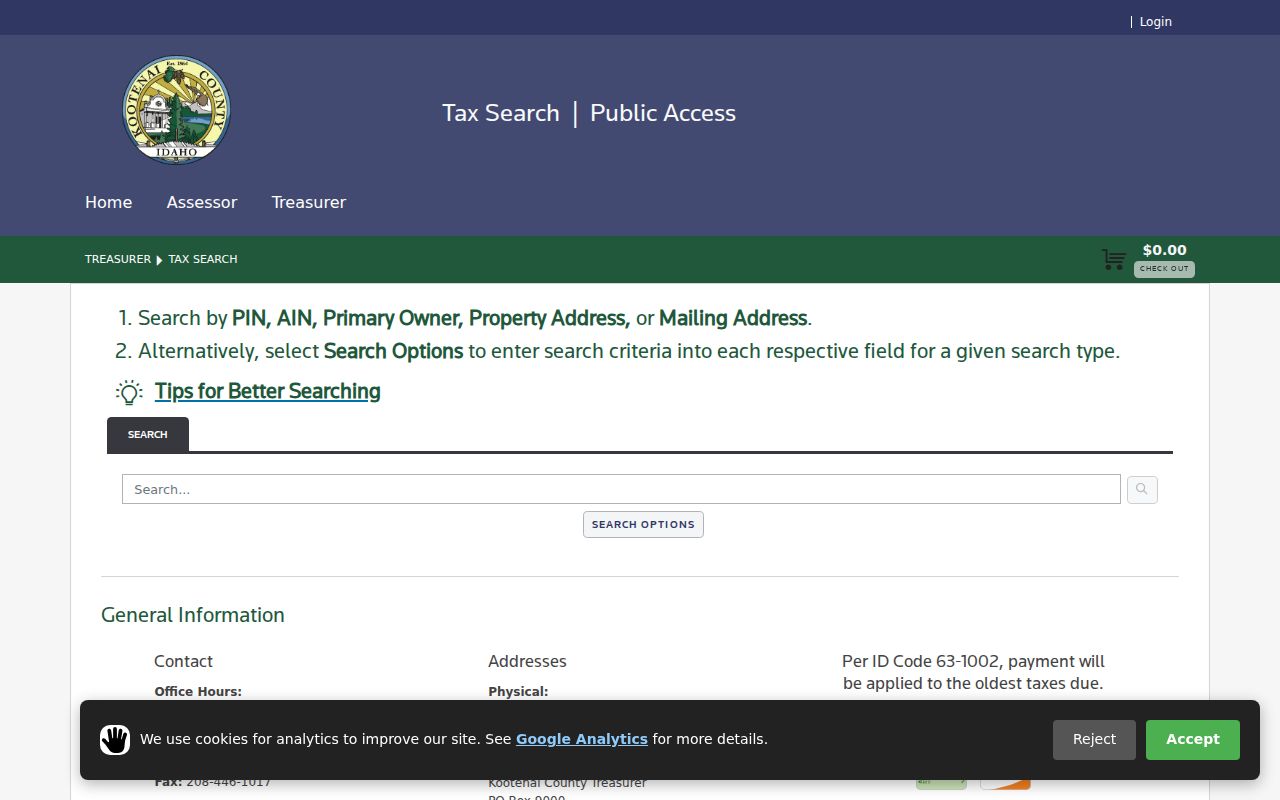
Tax due is not market value. Read any tax total beside the Assessor's dated valuation fields, since levy rates and exemptions shape what the county bills.
Kootenai Land and Improvement Values
A parcel result may split land, improvements, total, and net taxable value. Land is the assessed land component. Improvements generally cover buildings and other additions. Exemptions or caps can push net taxable value below the full assessment. The county publishes no fixed field schema or history cutoff for every field. Record only what the current official result displays. Never infer a missing component from the total.
Check the legal description first. One street address can cover several condominium units, separate buildings, or parent and child accounts. A value on the parent parcel should never be assigned to one unit, and acreage and building data help catch a mistaken match before comparing numbers.
Kootenai Value and 45 Districts
Kootenai County identifies 45 taxing districts. Most parcels fall in four to ten of them. The Assessor determines value, the Clerk calculates levy rates, and the Treasurer handles the tax account. Boundaries explain why similar values yield different bills.
Exemptions cut taxable value, not market value. Homeowner, timber, agricultural, circuit-breaker, and disabled-veteran programs each require an application. Their eligibility rules and tax effects are separate from the meaning of market value.
County and Tax Commission guidance says an appraisal should fall within a 90 to 110 percent range. That range is an assessment-administration measure. It is not a price band for one sale. No house must sell within ten percent of its assessed value because of it.
Kootenai Sale Price Differs
A recorded sale is history, not an appraisal. Match the deed's legal description to the parcel. CurrentSales points in KCEarth are clues only, never a substitute for the recorded instrument or its terms.
Tax-deed sales deserve extra care. County tax-deed lists show PIN, AIN, redemption, legal description, acreage, market value, and minimum bid. The county sells auction land as-is, with no promise about access, building rights, septic, or clear title. Minimum bid is not ordinary market value.
When the sale field and the deed disagree, compare instrument date, recording date, consideration wording, and legal description. Some transfers are not open-market sales. Trust, estate, corrective, or partial-interest deeds may carry a number that no typical buyer would pay for the whole parcel.
Note: Compare dated, similar sales and obtain a licensed appraisal when an independent property value opinion is needed.
Kootenai Property Value Limits
A Kootenai County assessed value is a mass-appraisal figure for tax administration. It promises no sale price. Nor does it replace an inspection, survey, title commitment, permit review, or private appraisal. Zoning and permit records explain use or improvement activity.
Countywide figures cannot value one parcel. Aggregate market, taxable, and exemption totals should never be divided into an estimate for a city, block, or house.
A purchase decision calls for a current inspection, comparable-sales analysis, and a qualified appraisal. Boundary or acreage questions call for a survey rather than an assessed figure. For title, use the Recorder and a title professional. Each tool answers its own question. That is why a Kootenai County property value can be accurate for its public purpose yet still be the wrong figure for another task.
Value versus price. Assessed value supports taxation and is not a promise of what property will sell for. Obtain a licensed appraisal for a private market opinion.