
What Kootenai County Property Tax Records Connect
Two custodians anchor Kootenai County property tax records. The Assessor sets fair market value and keeps the parcel and exemption context. Collection and distribution fall to the Treasurer, who maintains the bill and the payment route. One more office matters here. The county Clerk calculates levy rates. Those rates come from the budgets submitted by taxing districts.
| Field | What It Shows | Where |
|---|---|---|
| Assessed market value | January 1 value used in the tax process | Assessor |
| Exemptions and caps | Adjustments that reduce net taxable value when applicable | Assessor |
| Levy rate | Rate produced from the parcel’s taxing districts | County Clerk |
| Tax bill and status | Amount billed, due, paid, or delinquent | Treasurer |
| Tax-deed material | Sale, redemption, bid, and surplus information | Treasurer |
Idaho law assesses property at 100 percent of market value, minus any exemptions. Treat that assessed market value with care. It is not a promise of what the land will sell for. Net taxable value is what remains after eligible exemptions and caps, and the levy is applied to that figure through the tax process.
Search Kootenai County Tax Accounts With Five Keys
The Treasurer Tax Search accepts five entry modes: PIN, AIN, primary owner, property address, and mailing address. One of those fields is required. Typing less often returns more, and the wildcard * widens a term further.
| Mode | Expected input | Use it when |
|---|---|---|
| PIN | 12 letters or digits | The tax bill or Assessor record supplies it |
| AIN | Six digits | The assessment account is known |
| Primary owner | Owner-name term | A parcel key is not yet known |
| Property address | Street address term | The situs is known |
| Mailing address | Notice destination | The owner receives bills elsewhere |
A confirmed PIN or AIN is the best starting point. Owner and address searches can surface several candidates. Compare the land description before treating a balance as belonging to the intended parcel.
Kootenai County Values Property as of January 1
The annual assessment notice reports market value as of January 1 and generally arrives near the end of May. The county attempts a physical inspection once in a five-year cycle. A value can change because of improvements, nearby sales, or broader market movement even when the owner did not transfer the land.
County and Idaho Tax Commission guidance describes a 90 to 110 percent range around market value for appraisal context. That is not an appraisal of a specific home. A parcel-specific review should compare its characteristics and recent comparable sales rather than applying a countywide ratio as a shortcut.
Kootenai County Parcels Can Span Several Taxing Districts
Kootenai County counts 45 taxing districts. A typical property sits inside four to ten of them. School, city, fire, and library boundaries can mix differently from one parcel to its neighbor. The Clerk's levy rate multiplies against assessed value after exemptions.
KCEarth and county tax-district material help explain the geography. For the actual amounts, rely on the current bill. A ZIP code or city mailing label never establishes taxing jurisdiction. Annexations and boundary changes also shift, so the record year matters.
Look Up a Kootenai County Tax Bill Step by Step
A precise Kootenai County property tax search begins with the parcel account, not an estimate. Verify the land in the Assessor portal when the PIN or AIN is uncertain. Then run that same identifier through the Treasurer.
- Search the Treasurer by confirmed PIN or AIN, or begin with a broad address.
- Match the owner reference, situs, and legal description before opening the tax account.
- Read the current bill and payment status, then check any available prior-year material.
- Compare the Assessor record for value and exemptions applied to the parcel.
- If delinquency appears, use the official tax-sale page and Recorder filings for further due diligence.
- Assessed value
- The Assessor’s market-value figure for the tax year.
- Net taxable value
- Assessed value after applicable exemptions and caps.
- Levy rate
- The rate calculated from budgets of districts serving the parcel.
- Homeowner exemption
- An application-based program that may reduce taxable value for qualifying property.
- Tax lien
- A claim arising from unpaid property tax, distinct from a deed transfer.
Kootenai County Exemptions Require an Application
The county offers homeowner, timber, agricultural, state property-tax reduction or circuit-breaker, and disabled-veteran programs. None applies automatically. Each carries its own eligibility rules and application. A missing exemption on a parcel screen cannot be fixed through the Treasurer's payment record.
The Assessor's Property Tax Relief page identifies the right program and its current form. File the proof alongside the annual assessment notice. An exemption shapes net taxable value, while the assessed market value stays its own figure.
Separate Kootenai County Assessment and Payment Questions
A value dispute starts with the Assessor and, where needed, the appeal process. Payment, balance, and allocation questions go to the Treasurer. This split keeps an owner from challenging the collector over a market estimate. It also stops anyone from asking the Assessor to fix a posted payment.
The Treasurer office opens weekdays from 8:30 to 4:30. The phone line closes from noon to 1:00. Online payment takes debit card, credit card, or e-check, and processing fees may apply. Under Idaho Code 63-1002, a payment goes toward the oldest taxes due. The county summarizes the rule that way. Check every displayed year before assuming a new payment cleared the current bill.
Keep the payment confirmation, parcel key, and tax year filed together. A wrong mailing address is fixed through the Assessor's address-change process, which accepts the signed form by mail, fax, or the published assessor email routes. The form requests owner names, AIN or parcel number, old and new mailing addresses, phone, signature, and whether multiple parcels under the same name are included. Updating the mailing record does not change title.
Read Kootenai County Delinquency and Tax-Deed Records With Care
Tax-deed work is its own branch of Kootenai County property tax records. The county's sale material may list PIN, AIN, redemption status, legal description, acreage, market value, and minimum bid. Those fields support due diligence. They promise no access, condition, septic suitability, or clear title.
The 2026 auction is set for September 8. Dates, lists, and redemption status change, so verify them on the live page. The county sells property as-is, with no post-sale right of redemption. Surplus-fund procedures also run through the county's sale materials.
Contest a Kootenai County Assessment on Time
An owner may first discuss the parcel with the Assessor at 208-446-1500, but that conversation does not preserve a formal appeal. The appeal form is due by the fourth Monday in June and goes to the County Commissioners, after which a hearing is scheduled. Mail or hand-deliver the form, the assessment notice, and supporting evidence. County instructions say not to email or fax it.
Useful evidence includes accurate parcel facts and comparable sales. The county's comparable-property form asks for the subject name, address, AIN or parcel number, assessed value, and recent-purchase details, plus as many as four comparable sales with dates, prices, parcel keys, acreage, address, comments, and descriptions. The Board cannot lower a value solely because taxes are high or hard to pay.
Appeal window. A Kootenai County appeal is due by the fourth Monday in June. Calling the Assessor alone does not meet the formal filing requirement.
The county’s property-tax process guide is shown in the official capture below.
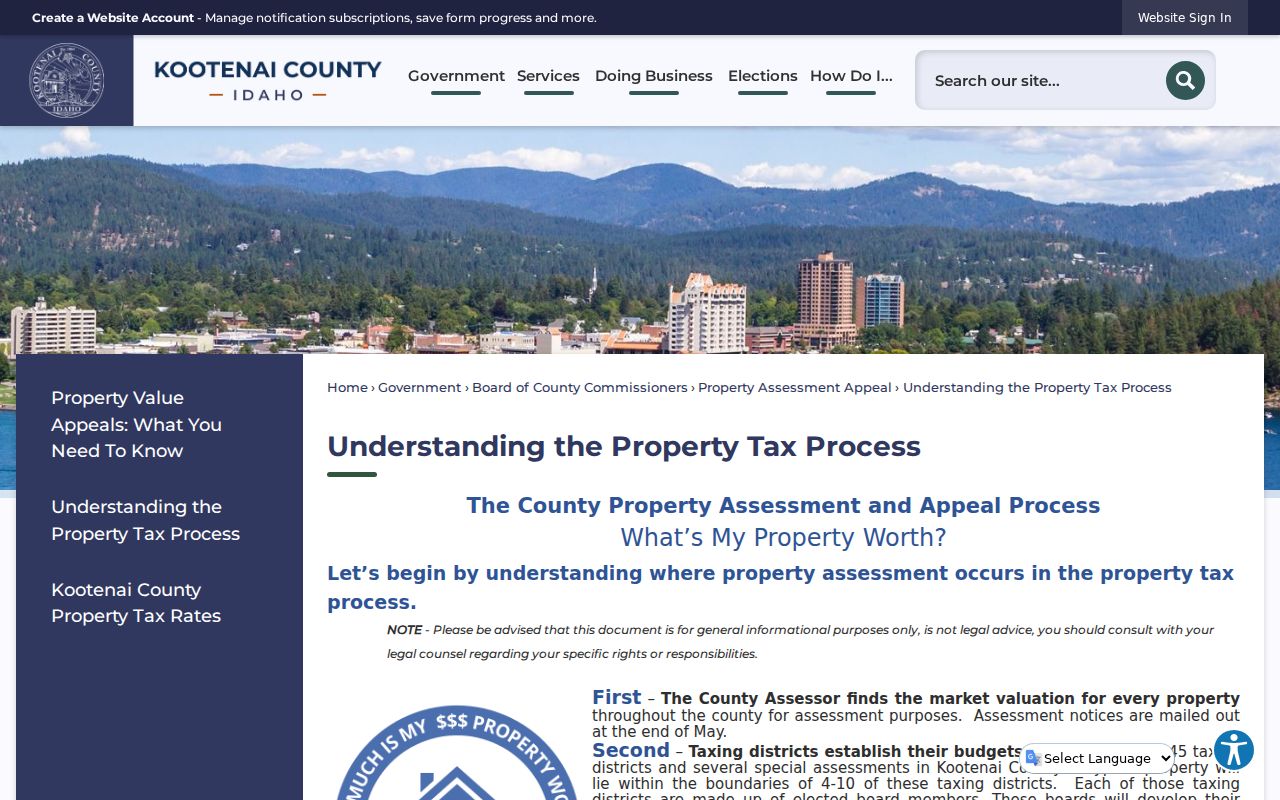
The guide places assessment, levy calculation, and collection in sequence while keeping each office’s role distinct.
The Assessor’s countywide figures provide scale, not a parcel estimate. As of January 1, 2025, the office reported more than 97,500 assessable parcels or accounts, $63.5 billion in full market value, $48.2 billion in net taxable value, and $15.3 billion in exemptions. Those totals should not be divided or applied to a particular property. Use the parcel’s own record, valuation date, characteristics, and exemption status.
A tax record also cannot answer every ownership question. Payment by a person does not make that person the title holder, and a primary-owner field is not a substitute for the latest recorded deed. When ownership matters, match the parcel’s legal description and PIN to the Recorder index. When value meaning matters, separate assessed market value, net taxable value, levy rate, bill amount, and any consideration shown on a deed.
District geography can explain why nearby parcels carry different totals. Kootenai County says a typical property falls within four to ten of its 45 taxing districts. Use the bill year and the parcel’s district assignments rather than copying a neighbor’s rate. A city mailing label or ZIP code does not establish city limits, and annexation can change the mix over time. KCEarth offers a useful district check, but the official bill remains the account source.
For an appeal file, keep the assessment notice, parcel characteristics, photographs when relevant, and verified comparable sales together. The county form provides space for up to four comparables, including sale date, price, AIN or parcel number, acreage, address, comments, and description. Explain factual differences instead of relying only on a lower nearby value. Most importantly, deliver the formal filing by the deadline even if an informal Assessor discussion is still underway.